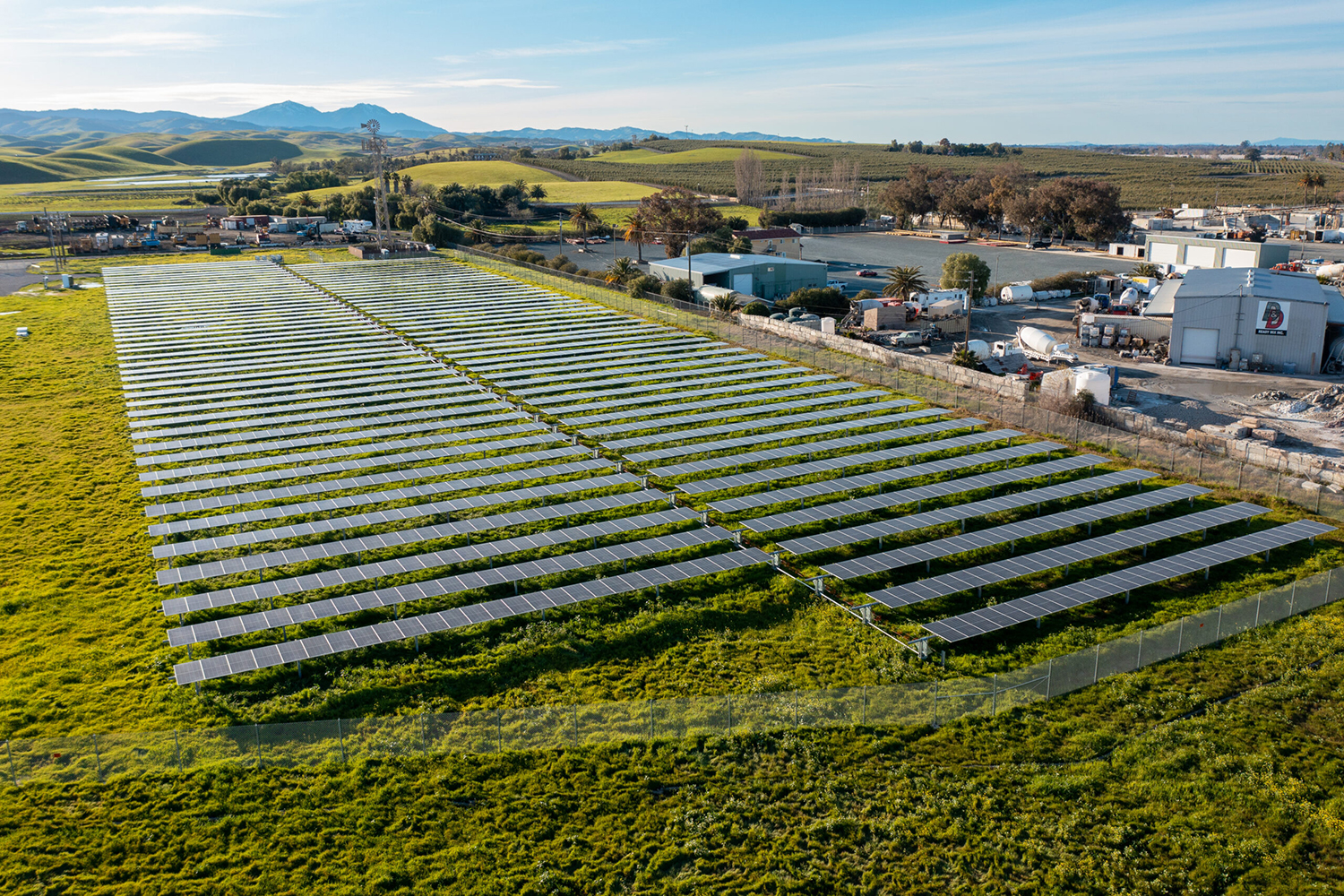
Our Byron Hot Springs Solar Project in Contra Costa County supplies power to 400 homes annually.
American Canyon Solar Project is MCE’s first Feed-In Tariff project in Napa County. The project’s annual output is estimated to generate enough clean, locally produced electricity to power approximately 1,000 homes per year.
The largest wastewater treatment facility in Marin County Central Marin Sanitation Agency (CMSA) creates a sustainable loop by converting the biogas produced by the waste treatment process into renewable energy. This system powers the agency’s facilities and delivers the excess renewable power to MCE through our Feed-In Tariff program.
This 1-megawatt solar carport shade structure is located at Buck Institute for Research on Aging, the nation’s first independent research facility focused solely on the connection between aging and chronic disease. Project construction was supported by Cupertino Electric, Inc., an IBEW 1245 Signatory contractor.
The Renewable Properties Byron Highway Solar project supplies energy through MCE’s Feed-In Tariff (FIT program). The project is pollinator-friendly and participates in the East Contra Costa Habitat Conservancy’s Habitat Conservation Plan.

The 1 MW Byron Hot Springs Solar project in unincorporated Contra Costa County has a 20-year term with Renewable Properties, a commercial solar energy developer.

With the help of Danlin Solar, REP Energy, and the Novato Cooley Quarry, MCE flipped the switch on the Cooley Quarry Solar Farm. The solar farm provides lower-cost 100% solar energy to low-income residents in several of the most environmentally impacted communities in the Bay Area through MCE’s Local Sol service.
Taking advantage of MCE’s FIT program, Rawson, Blum & Leon (RBL) is utilizing unused rooftop space at the Cost Plus World Market in Larkspur to produce 265 kilowatts of clean electricity. This project,developed by RBL and Alta Energy, came online in 2016.

EO Products’ San Rafael headquarters and manufacturing plant is the site of MCE’s sixth Feed-In Tariff (FIT) project: a 60-kilowatt rooftop solar installation. When the solar array isn’t generating electricity, EO Products’ operations are powered by MCE’s Deep Green 100% renewable energy service.

The Fallon Two Rock Road Solar Project was developed by Renewable America under a California Environmental Quality Act construction permit. The project, developed on agricultural land, supports multi-purpose land-use, allowing for sheep grazing between the solar arrays.

Freethy Industrial Park is a two-megawatt, ground-mounted solar project and MCE’s third Feed-In Tariff (FIT) project. Sunstall Inc. and the City of Richmond’s RichmondBUILD program provided labor to construct the solar panel installation, which supported 23 jobs.
The Hay Road Landfill project was built in agreement between Recology and G2 Energy. The project captures methane from the landfill and uses it to generate around-the-clock electricity while simultaneously reducing greenhouse gas emissions.

Lake Herman Solar in the City of Benicia was the first major solar project in Solano County, doubling the amount of solar energy produced in Benicia. The project is pollinator friendly with other environmental efforts including habitat planting and ongoing management to prevent previously dominant invasive nonnative and noxious species from re-establishing themselves.
Waste Management and MCE ushered in a new era of power generation with this state-of-the-art gas-to-energy plant that captures methane, a powerful greenhouse gas, and uses it to generate electricity 24 hours per day. A sophisticated, multistep scrubbing system removes harmful air pollutants making this plant the first of its kind to be nearly emissions free.
MCE Solar Charge was built by the Marin-based American Solar Corporation, with EV stations funded in part by the Transportation Authority of Marin and Bay Area Air Quality Management District. The project pairs an 80-kilowatt photovoltaic solar system with 10 Level 2 EV charging ports to provide public EV charging powered by 100% renewable energy.

MCE Solar One was conceived by the Richmond community to repurpose a 60-acre remediated brownfield site. MCE teamed with local green job training academy RichmondBUILD to train and hire skilled local graduates for the project which required a 50% local resident workforce to maximize economic benefits.
Located on top of a storage facility, Napa Self Storage 2 will supply 0.65 MW of solar power over its 20-year term with Shorebreak Energy Developers. The project started operation in 2023 and was constructed with prevailing wage labor and 50% of labor hours coming from within MCE’s service area.
Owner and solar developer Hayworth-Fabian, LLC, increased its commitment to sustainability by expanding on an existing solar carport shade structure in 2018 and again in 2022.. The additions were developed under MCE’s Feed-In Tariff program.
Airports have a lot of roof space to spare, so why not convert it into solar power-generating surfaces? In 2012, that’s exactly what the San Rafael Airport decided to do. As MCE’s very first local project, this 2 MW site supplies enough clean locally generated electricity to power 600 homes per year.
Silveira Ranch Solar is an 11-acre solar installation in Marin County developed in partnership with Renewable Properties. Portions of the project site will be grazed by cattle to support on-site agricultural use.
The Soscol Ferry Solar installation in Napa was deployed at the end of 2020 on land that was previously a vineyard. It was also the first commercial-scale solar installation in the County to install a pollinator plant meadow, using a native seed mix to attract pollinator species such as bees and monarch butterflies.

Contractors, please fill in all required fields below. Information must be submitted for each project for which you are requesting to reserve funds.